
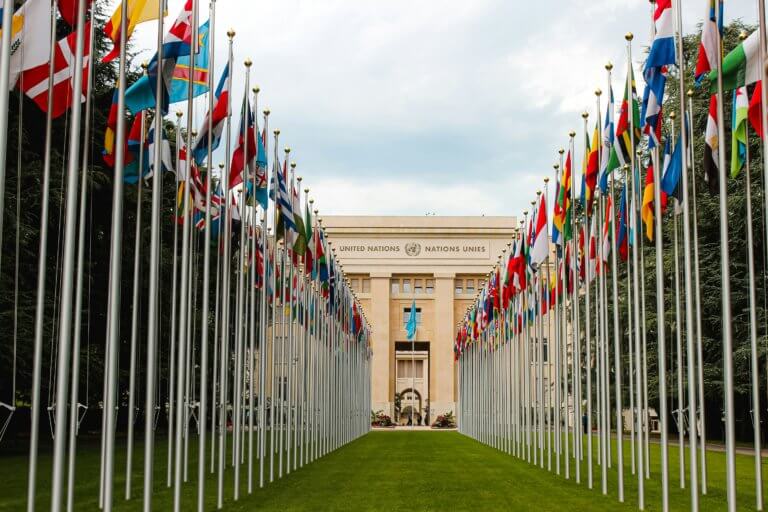
UN General Assembly backs ‘historic’ climate resolution
On the 20th May the UN General Assembly approved a “historic” resolution calling on countries to comply with their climate obligations, as stated by the landmark advisory opinion that was published last year by the International Court of Justice (ICJ).
Last July, in the opinion first requested by the Pacific island state of Vanatu, the court ruled that harming the climate by increasing fossil fuel production may constitute an “international wrongful act”. This could allow affected countries to claim compensation from those responsible.
Following on from this a dozen nations, led by Vanuatu, submitted a proposal to the UN to recognise the advisory opinion and find ways to implement it.
Several large oil-producing attempted to amend the resolution to weaken the text, but this was rejected and the UN adopted the resolution with 141 countries in favour.
The resolution urges countries to employ measures to cut carbon emissions, including by tripling renewable energy capacity, “transitioning away from fossil fuels in energy systems”, and phasing out “inefficient” fossil fuel subsidies.
Recycling could meet half of Europe’s critical mineral needs by 2050
Recovering critical minerals from waste such as used batteries, end-of-life vehicles and electronic equipment could meet more than half of Europe’s demand by 2050, a new report says.It would also reduce their dependence on imports of critical minerals vital for manufacturing clean energy technologies – from electric vehicles (EVs) to solar panels and wind turbines.
Some of these critical minerals include lithium, cobalt and rare earth elements which are largely lost during collection or waste processing.
In 2022, about 2 million metric tons of these minerals were contained in waste. This is expected to grow to up to 6 million tons by 2050 in the 27 EU countries plus Switzerland, Norway, the UK and Iceland.
From the 2 million tons of critical minerals found, about half was recovered as “secondary raw materials”, which means they are collected in some form but not processed. If all these secondary raw materials already collected were functionally recycled, they could supply up to 56% of Europe’s critical minerals demand by 2050, the study estimates.
El Niño expected to bring next record-hot year as soon as 2027
The weather system ‘El Niño’ could make 2027 the hottest year ever, the UN’s weather agency has warned.
The World Meteorological Organization (WMO)’s has predicted that there is an 86% chance that at least one year between 2026 and 2030 will surpass 2024 as the warmest year on record.
Global average temperatures reached 1.55C above pre-industrial levels in 2024, when the last El Niño event supercharged human-made warming primarily caused by the greenhouse gas emissions generated through burning fossil fuels.
Meteorologists expect El Niño – a natural climate pattern marked by unusually warm ocean surface temperatures in the eastern Pacific Ocean-to start developing as early as this month.
Researchers warn that a strong El Niño risks exacerbating extreme weather conditions, leading to more severe wildfires, droughts, storms and floods.
It has also been reported that there is a 91% chance that the key 1.5C warming threshold will be temporarily exceeded again for at least one year between 2026 and 2030. This occuring in a single year does not mean that themost ambitious global warming goal enshrined in the Paris Agreement has been lost. But the UN conceded last year that a “multi-decadal” breach is very likely to happen within the next decade.