
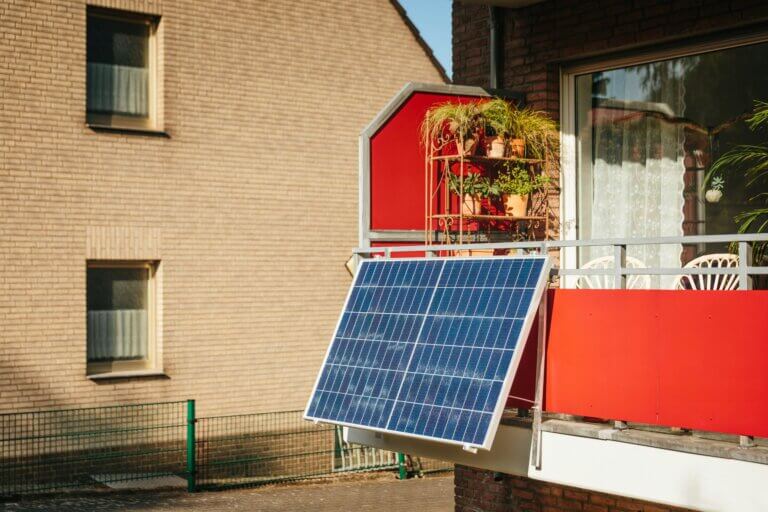
Plug-in solar panels are coming to UK shops
Solar power could soon become more accessible to households across the UK, with plug-in solar panels now legal to buy and use in Great Britain.
Unlike traditional rooftop solar, these smaller systems are designed to be much easier to install. They can be placed in outdoor spaces, including some balconies, and plugged directly into a standard household socket. The government says compliant systems can generate up to 800W of power, potentially providing up to 20% of an average home’s electricity use.
The new rules came into effect on 27 August 2026, with major retailers including Argos, Amazon, B&Q, Currys, Screwfix and Wickes among those planning to stock plug-in solar products.
The government estimates that a household could save up to £110 a year on its electricity bills. However, savings will depend on factors such as the amount of sunlight available, the size and position of the panels and how much of the electricity generated is used in the home. Plug-in systems also produce less electricity than a typical rooftop solar installation.
For households that cannot install traditional solar panels, plug-in systems could provide another way to generate renewable electricity at home. They could be particularly useful for properties where rooftop solar isn’t practical, including some homes with balconies or other suitable outdoor spaces.
There are also potential benefits beyond individual households. Generating more electricity from renewable sources can help reduce reliance on fossil fuels and support the UK’s wider transition towards cleaner energy.
Although plug-in solar is designed to be easy to install, safety is still important. Only compliant products that meet the UK’s requirements can be legally sold and used. Households should also check whether they need permission from a landlord, freeholder or planning authority before installing a system.
At present, the rules allow one plug-in solar product per household, with a maximum rated output of 800W.
Ancient Skills Are Helping a Rare Bee
Sometimes, looking after nature means looking back to the past.
At Muchelney Abbey in Somerset, traditional scything techniques are being brought back to life as part of a three-year project helping to restore flower-rich meadows for one of Britain’s rarest bumblebees — the Shrill Carder bee.
Using traditional hand scythes instead of modern machinery allows the meadows to be managed in a way that can benefit wildflowers and the insects that depend on them. The work is also giving volunteers the chance to learn and practise a traditional countryside skill that has been used for centuries.
The project aims to create healthier, more diverse meadow habitats where Shrill Carder bees can find the flowers and nesting areas they need to thrive.
It’s a great example of how traditional knowledge and modern conservation can work together — protecting wildlife while keeping valuable rural skills alive for future generations
August Ties for the Hottest Month on Record
August 2026 was the joint hottest August ever recorded, with global temperatures reaching around 1.65°C above pre-industrial levels, according to the EU’s Copernicus Climate Change Service.
The temperature was the same as that recorded in July 2023, which currently shares the record for the hottest month on record.
So, what does 1.65°C actually mean? Temperatures are compared with the 1850–1900 average, a period before fossil fuels were being burned on the scale we see today. The continued rise in global temperatures is contributing to more frequent and intense heatwaves and other extreme weather events.
August brought extreme heat across parts of Europe, contributing to drought conditions in countries including the UK, France, Hungary, Serbia and Romania. Rivers including the Rhine and Danube also experienced exceptionally low water levels.
The UK has also experienced an unusually hot summer. The Met Office has reported that summer 2026 was the hottest summer on record, with average temperatures around 0.4°C higher than the previous record.
In 2015, countries agreed through the Paris Agreement to try to limit global warming to well below 2°C above pre-industrial levels, while pursuing efforts to keep warming to 1.5°C.
With temperatures continuing to reach record levels, the impacts of climate change are becoming increasingly visible — from extreme heat and drought to pressure on water supplies, wildlife and ecosystems.
The news comes ahead of COP31, the next major UN climate conference, which will take place in Antalya, Türkiye, in November. The conference will bring countries together to discuss further action on climate change.